Notes from Jesse Keeler’s 2020 Winter Solstice Celebration presentation.
Overview
On the 2020 Winter Solstice (Monday December 21, 2020) a special astronomical event that was visible in the early evening sky, the Jupiter Saturn Conjunction. A planetary conjunction is when planets appear very close to one another in the sky because of the way they line up with Earth in their respective orbits. This conjunction was unique because the planets will appear less 0.1 degrees apart or about one-fifth of the apparent width of the moon.
A Jupiter Saturn Conjunction occurs every 20 years, but what makse this conjunction special is the last time these two planets were this close together was 400 years ago in July of 1623. A little more than a decade after Galileo discovered Jupiter’s moons. Although, at that time the conjunction wasn’t visible in the sky.
We have to go back 800 years to March of 1226 to the last time the conjunction was as close, and was visible to most people on Earth. Think about that for a moment, we experienced an astronomical event that people haven’t experienced in 800 years. This event gave us an opportunity to view a similar night sky and connect with our ancestors across centuries. How different is today from their world? What do we have in common that time has not changed?
How the Conjunction Works
In the center of the diagram to below is our Sun. Three planets out from the sun is our Earth. Then moving out about 550 million miles from Earth we get to Jupiter. Then another 450 million miles from Jupiter we get Saturn. You can see in December of 2020, Jupiter and Saturn have moved in their orbits so they appear to be in alignment with one another from our vantage point on Earth.
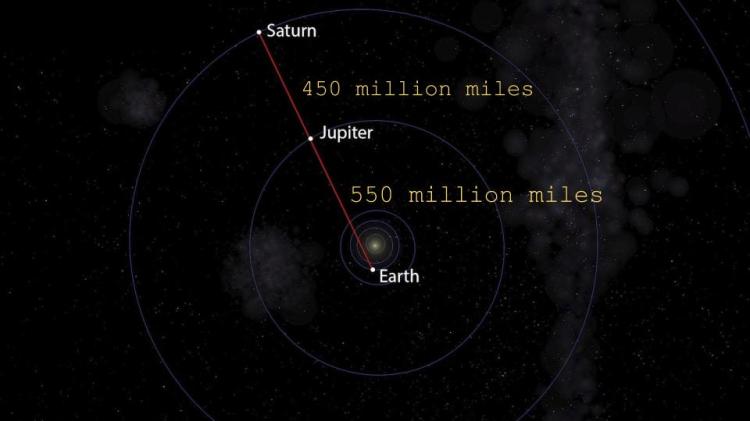
What did the Jupiter Saturn Conjunction look like from Earth?
Jupiter is brighter than any star. Although Saturn isn’t as bright as Jupiter, it is as bright as the brightest stars and has a distinctly golden color. The planets’ light shines steady, unlike the twinkling of stars. As they drew closer to one another they were noticeable for their brightness. As a fun fact, some people called this conjunction the “Christmas star”, because it is believed there was a similar conjunction at the time of Jesus’ birth that guided the Maji to the manger in Bethlehem.
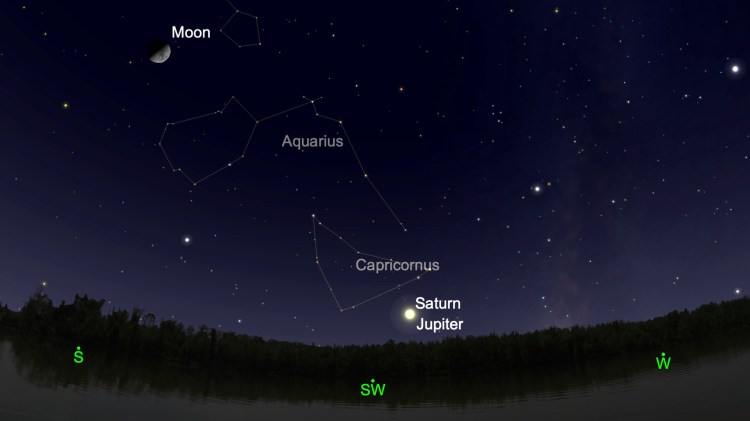
To view this astronomical event point people gazed toward an unobstructed view of the southwestern sky, about an hour after sunset. Note the planets did not rise very high in the sky and dipped back below the horizon very quickly. On December 21, Saturn appeared to the left of Jupiter, in the days following the planets appeared to change places, with Jupiter appearing on the left and Saturn to the right.
See ‘The Interactive Night Sky Map’ viewer on the ‘Time and Date’ site to locate planets and stars in the night sky from your location.
References
The following resources were last retrieved December 21, 2020
- The ‘Great’ Conjunction of Jupiter and Saturn. NASA.gov. https://www.nasa.gov/feature/the-great-conjunction-of-jupiter-and-saturn
- Jupiter and Saturn’s great conjunction is December 21. EarthSky.org. https://earthsky.org/astronomy-essentials/great-jupiter-saturn-conjunction-dec-21-2020
- ‘Christmas star’ 2020: Here’s some fun facts about the ‘great conjunction’ of Jupiter and Saturn. Space.com. https://www.space.com/great-conjunction-jupiter-saturn-2020-fun-facts
- ‘Great Conjunction’ 2020: NASA tips to see Jupiter and Saturn shine as a ‘Christmas Star’. Space.com. https://www.space.com/great-conjunction-jupiter-saturn-christmas-star-2020-nasa-tips
- A magnified view of Jupiter and Saturn at conjunction. EarthSky.org https://earthsky.org/astronomy-essentials/jupiter-saturn-conjunction-telescopic-magnified-dec-2020
 Order of the Sacred Earth OC
One thought on “The Jupiter Saturn Conjunction”